The Red Light Mat Buying Guide: Five Specs That Matter, Three That Don't

A red light mat is a flexible pad full of LEDs emitting red light around 660nm and near-infrared light between 810 and 850nm. You lie on it with bare skin, the light gets absorbed by tissue, and a substantial body of research connects those wavelengths to cellular energy production, skin health, and recovery, with the honest caveat that home-device studies are thinner than the marketing implies. That's the technology. Everything else on the sales page is either a real differentiator or decoration, and this guide sorts which is which.
The Five Specs That Matter
1. NIR coverage, not LED count
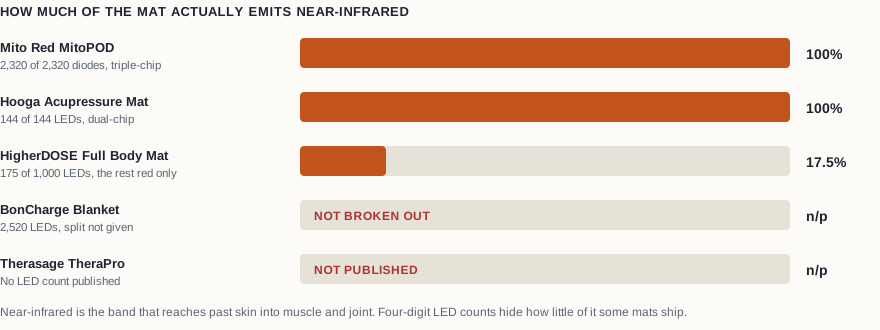
This is the spec the marketing buries and the one that should drive your decision. Near-infrared is the wavelength band that penetrates past skin, and brands quietly vary in how much of it they ship. The MitoPOD puts NIR chips in 100% of its diodes. The HigherDOSE mat puts them in 175 of its 1,000 LEDs, with the other 825 emitting red only. Both advertise themselves with four-digit LED counts. Ask one question of every mat: how many of those LEDs emit NIR? If the answer isn't published, that is also an answer.
2. Irradiance, and the shell game around it
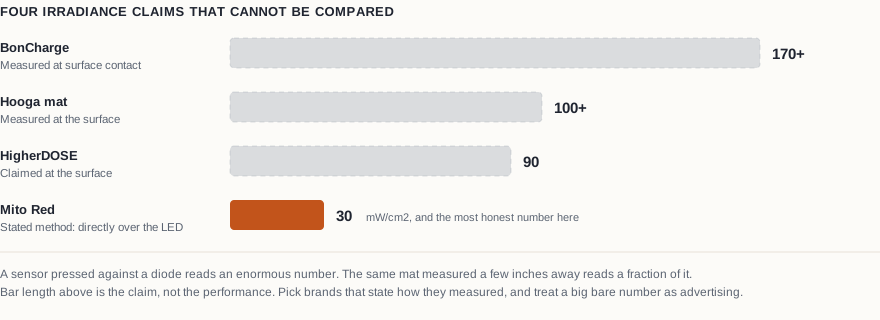
Irradiance, measured in mW/cm², is light power per area, and in this category the numbers are functionally incomparable across brands. Here's the trick: a sensor pressed directly against a diode reads enormous values. The same mat measured a few inches away reads a fraction of that. So BonCharge claims over 170 mW/cm² at the surface, Hooga claims over 100 at the surface, HigherDOSE claims 90, and Mito claims 30 measured directly over the LED, and the smallest number on that list may be the most honest spec of the four. Don't pick a winner by comparing the figures. Pick brands that state how they measured, and treat any big number with no methodology as advertising.
3. Wavelengths
The well-studied combination is 660nm red plus near-infrared somewhere in 810-850nm. All five mats we cover use it in some blend. What varies is the ratio: recovery-focused buyers want a meaningful NIR share (Mito runs 67% NIR), skin-focused buyers do fine with red-heavy designs. Exotic extra wavelengths are mostly menu padding.
4. Warranty and the return window
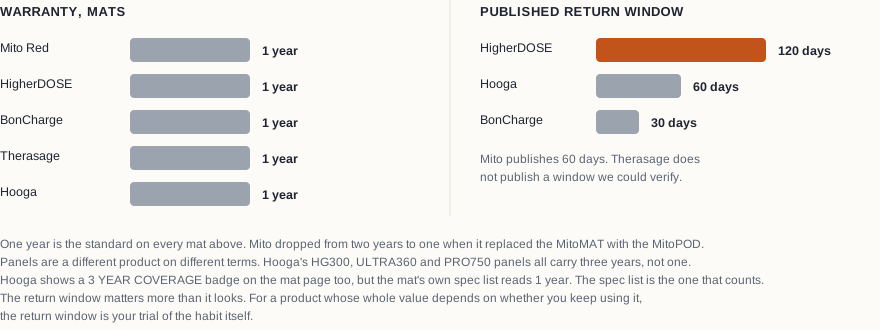
One year is now the category standard across every product here, including Mito, which dropped from two years to one when the MitoPOD replaced the MitoMAT. That makes return windows the more useful signal: HigherDOSE gives 120 days, Hooga 60, Mito 60, BonCharge 30. For a product whose entire value depends on whether you keep using it, the return window is your trial of the habit itself. Weight it accordingly.
5. EMF, published versus claimed
Any powered device produces some electromagnetic field. Well-designed mats measure near zero at the surface, and the brands doing it right publish the number: Hooga prints 0µT at contact, Mito states low EMF and flicker-free design. The science on low-level EMF harm is genuinely unsettled, so our position is practical: for something pressed against your body hours a week, prefer a published figure over a vague badge. And no, shungite crystals do not neutralize EMF, whatever a certain product page implies.
The Three Specs That Don't Matter
Gemstone layers. Jade, rose quartz, amethyst, tourmaline, shungite. Stones can hold and spread heat in a heated pad, and that part is legitimate. The emotional healing, spiritual connection, and EMF neutralization claims are decoration with a markup. Pay for diodes, not minerals.
40Hz pulsing and exotic light modes. Pulsed-light marketing leans on early-stage research from unrelated contexts. Treat pulse modes as a free extra, never a reason to choose one mat over another.
Total chip counts. "6,960 chips" and "1,000 LEDs" and "2,520 LEDs" are all counting different things. Diodes, chips per diode, and wavelength per chip get blended into whichever number sounds biggest. Translate everything back to the question in spec #1: how much of this surface emits NIR?
Safety, Without the Lawyer Voice
- Use bare skin. Light doesn't meaningfully pass through clothing, and a session through a shirt is mostly a warm nap.
- Start at 10-15 minutes and see how your skin responds before going longer. More is not better with light dosing; established protocols live in the 10-20 minute range.
- If you take photosensitizing medication (some antibiotics, retinoids, St. John's wort, others), clear it with your doctor or pharmacist first.
- Pregnant, managing cancer, or have an implanted electronic device? Doctor first, device later. PEMF-equipped pads like the TheraPro are explicitly not for pacemaker users.
- Don't stare into the LEDs. Mats point away from your eyes by design, which is one of their quiet advantages over panels.
The Cost Math
Red light studio sessions run $25-60 each. A $199-1,199 mat used four times a week pays for itself in one to six months, then produces years of near-free sessions at pennies of electricity. The only losing outcome is the one where it goes under the bed forever, which is why the most important spec of all is the honest answer to: will you lie still for 15 minutes, repeatedly, forever? If you're not sure, start with the $199 Hooga and its 60-day trial, not a four-figure flagship. If you're not sure you want a mat at all, read mat vs panel first.
FAQ
- What's the real difference between red and near-infrared light?
- 660nm red works mostly at skin depth. 810-850nm NIR penetrates toward muscle and joint. Recovery buyers should prioritize NIR coverage; skin-focused buyers can go red-heavy.
- Can I compare irradiance numbers between brands?
- Mostly no. Measurement distance and method vary so much that a stated-methodology 30 mW/cm² can beat an unexplained 170. Trust methodology, not magnitude.
- How often should I use a mat?
- Typical guidance is 10-20 minutes, three to seven days a week. Consistency over weeks beats marathon sessions.
- Do they work through clothes?
- No. Bare skin or nothing. Plan your sessions accordingly.
Where to Start
Our current picks by buyer type are on the 2026 comparison page. Short version: MitoPOD for the most real light per dollar, HigherDOSE for polish and the 120-day window, BonCharge for double-sided coverage, Therasage for heat and PEMF in the same pad, Hooga if you're new and sensible.